Bike trackers and AirTags: choosing and mounting
All covered countries
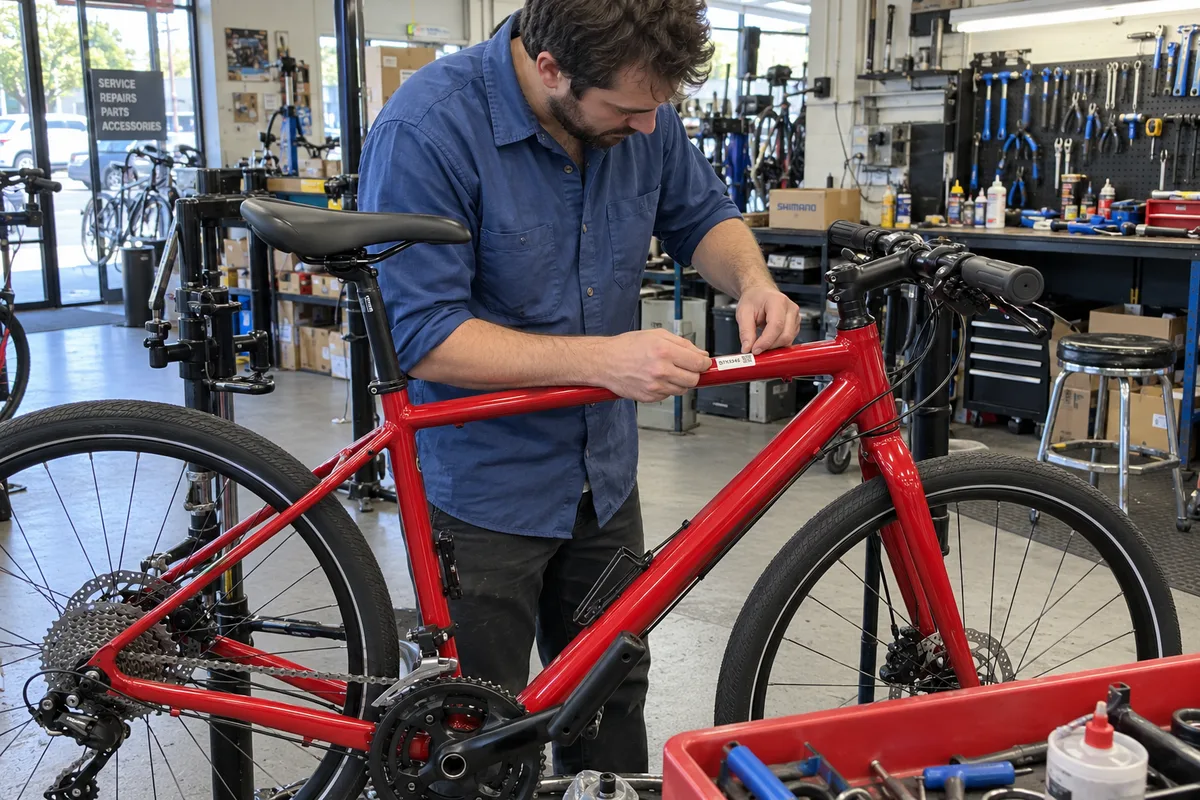
Illustrative photograph.
For a conventional bike, a tag compatible with your phone can add a location lead without a mobile subscription. For alerts when you are away from the bike and location updates as it moves, consider a connected GPS tracker. Choose the mounting arrangement before buying either.
Which approach suits your bike?
The choice depends on your phone, the bike you are equipping and what you expect when you are no longer nearby. A location on a map, close-range finding and a movement alert are different functions.
| Solution | What it offers | Main compromise |
|---|---|---|
| AirTag | Location through Apple’s network, replaceable battery | Requires compatible Apple equipment and nearby network devices |
| Chipolo POP | Choice of Apple or Google network to suit your phone | One network at a time; different shape from an AirTag |
| Galaxy SmartTag2 | Finding within Samsung’s ecosystem | Requires a compatible Galaxy device |
| Knog Scout | A frame-mounted tag and audible alarm | Choose iPhone or Android version; movement notifications within Bluetooth range |
| Standalone GPS, such as Invoxia Pro Max | Mobile transmission without bike power | Recharging, subscription and a larger enclosure |
| Integrated GPS, such as Bosch or PowUnity | Bike power and a dedicated installation | Bike compatibility, fitting and a paid service |
This selection compares documented approaches and products, rather than every model on the market. Specifications and prices were checked on 9 November 2026. Performance claims remain the manufacturers’ claims: we have not tested these devices on a bicycle.
How does a location reach your phone?
A Bluetooth tag relies on devices passing nearby
An AirTag broadcasts a signal detected by devices in the Find My network, which relay a location to its owner. Your own phone does not have to stay near the bike. However, the tag needs encounters with that network to supply fresh locations from a distance.
Close-range Precision Finding is a separate function. It helps compatible equipment find a nearby item; it does not turn the tag into a satellite transmitter.
On Android, Google explains how the Find Hub network works. Some settings on participating devices wait for multiple detections before reporting a location. The number of phones in a country therefore does not establish how quickly your tag will update in a particular bike park.
A GPS tracker must also transmit its location
GPS determines a position. To send it to you away from the bike, a connected tracker also uses a mobile network and an active service. Check satellite reception, transmission coverage and power. A phone getting a signal at the parking spot does not prove that the tracker’s particular mobile network works there.
A basement can prevent a fresh location reaching you. With any device, look at the last detection time before interpreting the map. A position from this morning does not establish where the bike is now.
Which devices should you compare?
AirTag: a straightforward addition for an iPhone owner
An AirTag suits someone already using Apple equipment who accepts network-dependent location updates. Its CR2032 battery is replaceable. The second-generation technical specifications give a diameter of 31.9 mm and a height of 8 mm, useful when choosing a mount. Also check phone compatibility and the requirements for close-range finding features.
The practical advantage is avoiding regular USB charging and a mobile subscription. You still need a separate mount, battery maintenance and checks of received locations. A notification that a tag has been found is different from a movement alarm sent as soon as someone touches the bike.
Chipolo POP: a choice between Apple and Android
The Chipolo POP works with Find My or Find Hub, one network at a time. It is worth considering if you want the option of changing phone ecosystems; switching requires setting it up again. Its battery is replaceable. Its shape and splash protection differ from an AirTag’s: choose an enclosure that fits the POP, rather than an accessory merely labelled “bike tracker holder”.
Galaxy SmartTag2: for a Samsung user
The SmartTag2 uses the Galaxy finding network. It has a replaceable battery and integrates with Samsung’s ecosystem. That makes it an option for an existing user, but “Android” alone does not establish compatibility: check your Galaxy model and available functions. A round AirTag enclosure will not automatically accommodate its longer body.
Knog Scout: a bike alarm and tag in one assembly
The Scout attaches to bottle-cage mounting points, optionally beneath the cage, and recharges through USB-C. Knog sells an Apple Find My version and an Android version using Google’s network. Choose the correct version before ordering.
Its advantage is avoiding a separate tag-and-alarm assembly. The important limitation is that Knog describes movement notifications to your phone within Bluetooth range. Network-based finding is a separate function. The claimed interval between charges is two to six months depending on use, so keep the charging port accessible.
Invoxia Pro Max: standalone GPS that needs space and charging
The Pro Max combines GPS with LTE-M, a mobile-network technology. It does not need power from the bike. However, its stated dimensions, 11.3 × 3.9 × 1.9 cm, require a proper mounting location. USB-C charging and a subscription are part of ownership. The claimed six-month battery life is a maximum dependent on update frequency, not a promise of six months of intensive tracking.
The attraction is fitting a bike without touching its motor or wiring. The compromise is keeping the enclosure accessible enough to recharge, while securing it so that it stays with the bike. Check country coverage for the exact model; different trackers from one brand do not necessarily use the same network.
Bosch ConnectModule: for a compatible Bosch-equipped bike
Bosch states that location tracking after theft requires a ConnectModule, Flow+ and a compatible bike. Digitally locking motor assistance alone does not provide it. Integration reduces the accessories attached outside the bike, but the module is not a universal choice for every e-bike.
The ConnectModule page distinguishes BCM3100 and BCM3101 versions. Have a dealer check the equipment already installed, the appropriate kit and its fitting location. This avoids buying a module for an already equipped bike or assuming that a feature described for one version exists on another.
PowUnity: another integrated e-bike approach
The PowUnity tracker, previously called BikeTrax, takes power from the bike. Its attraction is a permanent installation; its limitation is choosing the correct connection for the motor. The manufacturer’s FAQ explains installation and power constraints. Confirm the fitting arrangement and how backup power works when the main bike battery is removed.
Where can you hide an AirTag on a bike?
Balance discretion, secure attachment and maintenance. A deeply hidden tag that cannot report a location or be reached for a battery change is poorly placed. These mounts are documented examples; check availability and compatibility with the generation you are buying.
Beneath a bottle cage: accessible for maintenance
The Elevation Lab TagVault Bike mounts underneath a bottle cage or on its own at the cage mounting points. You can retain your existing cage. The Topeak Cage Mount also puts an AirTag enclosure in this area of the frame.
The benefit is keeping the tag outside the frame tube while retaining maintenance access. Check bolt length, bottle clearance and the frame’s specified tightening torque. Security screws make opening harder with an ordinary tool; they do not make the assembly impossible to remove.
Under the saddle: no frame mounting points needed
The Lezyne Matrix Saddle Tagger clamps to saddle rails. It is useful when the bike has no spare mounting points. Check clearance, rail compatibility and interference with a saddlebag or rear light.
There is a concrete drawback: if the saddle and seatpost are removed, the tag goes with them. You would then be locating that assembly, rather than necessarily the frame.
Inside a bell: no extra frame enclosure
The AirBell for AirTag has a compartment inside the bell. The manufacturer lists variants for different handlebar diameters. Measure at the intended fitting point instead of relying on a label such as “road bike” or “city bike”.
This avoids another enclosure on the frame, but the bell remains removable. Check battery-compartment access and keep the opening tool. An AirBell designed for a different finding network is not necessarily an enclosure for your AirTag.
Under the fork: only with a compatible mount
The TagVault Mountain Bike is designed for certain tapered-steerer forks. Elevation Lab specifies an internal diameter of 32 to 34.4 mm and excludes older straight steerers.
It offers a discreet position, but compatibility with your exact fork must be established before purchase. Do not treat this example as an instruction to push a loose tag into a tube or modify the headset.
Inside the rear tubeless tyre: discreet, with more maintenance
The Muc-Off Stealth Tubeless Tag Holder attaches to a compatible valve in a tubeless setup. The manufacturer recommends a tyre at least 38 mm wide and excludes inner tubes and tyre inserts.
The enclosure is out of sight. The tradeoff is that installation and battery changes require work on the tyre. Removing the wheel also separates the tag from the frame. Check the valve, rim and tyre combination before choosing it; this is not a mount for every road-bike wheel.
Can you just put the tag inside the frame?
Do not generalise a purpose-built fork mount to every cavity in a bike. Materials surrounding a device can interfere with its signals. Invoxia’s placement guidance advises against metal compartments for the model it covers. That is not a test of every AirTag mount, but it is a reason to test the actual position rather than choosing solely for concealment.
Avoid drilling the frame, trapping a device near moving parts or improvising a battery connection. For a tracker powered by the bike, follow its manufacturer’s kit and fitting procedure.
What does it cost beyond the tracker itself?
Add the device, mounting accessories, any installation charge and running expenses over the time you expect to keep the bike.
- Tag without a mobile subscription: Apple France lists a single AirTag at €35 on the check date. Add the mount, delivery and replacement batteries. This excludes the cost of a compatible phone.
- Standalone GPS: Invoxia advertises one included year for the Pro Max, followed by €59.95 a year. Two renewals therefore add €119.90 to the hardware and mounting costs over three years. This is not an all-in purchase price.
- Integrated GPS: the retrofit offer in PowUnity’s FAQ lists €199.90 including the first year, then €39.50 a year on the annual plan. That gives €278.90 over three years, before fitting and any other excluded charges. Already equipped bikes can have different terms.
These figures describe specific euro offers, not prices applying in every country. Check the checkout total, included term and renewal before paying. For Bosch, request the local cost of any missing hardware, fitting and Flow+.
What would suit three common situations?
Conventional bike and iPhone: start by checking whether an AirTag beneath the bottle cage meets your needs. It keeps the installation accessible with relatively little maintenance. If you want an audible alarm, compare the iOS Scout, keeping its Bluetooth notification limit in mind.
Android phone outside Samsung’s ecosystem: compare the POP configured for Find Hub with the Android Scout according to your alarm needs and mounting options. Do not order a SmartTag2 on the assumption that every Android phone is compatible.
Electric or cargo bike needing remote alerts: first have its existing equipment checked. Compare Bosch integration if supported, then a retrofit solution suited to the motor. Standalone GPS remains another approach if you can secure and recharge it. Space, fitting and several years of running costs can separate these choices.
A tag and a mobile-connected GPS tracker use different transmission paths. Combining them can offer a second lead, but putting both in the same signal-blocking position does not solve that problem. Start by checking each installation.
How do you check that the installation works?
Run a practical check before relying on the device:
- Pair the device and confirm that it works before closing its enclosure.
- Repeat after fitting, with the complete bike: bottle, bags and battery in their normal positions.
- Have a trusted person move your own bike with their knowledge and agreement while your phone stays at a distance.
- Record the departure time, last received location and observed delay. For a mobile-connected GPS tracker, check that a location arrives without your phone’s nearby Bluetooth connection.
- Try your usual parking place and the alerts supported by the model. A successful outdoor check does not validate a basement.
- Set a maintenance reminder. Check charge or battery condition after a long unused period and during routine bike maintenance.
Example: if the device remains visible beside you but stops updating when you leave, you have checked the local connection, rather than remote transmission. For a network-based tag, try several journeys and times before blaming the mount alone. That remains a local check, rather than a general coverage measurement.
What if the bike is stolen?
Keep the device’s name, location records, their times and useful screenshots. Add your identification photos and frame number, then give these to the police using the procedure for the country where the theft happened. A displayed position does not justify confronting someone or entering private property.
A discreet tag may eventually be noticed: Apple documents alerts and sounds against unwanted tracking. Keep these protections intact. Your mounting choice should not depend on defeating them.
For everyday parking, keep a good method for locking the frame and wheels. For e-bike identification records, see frame, battery and component numbers.